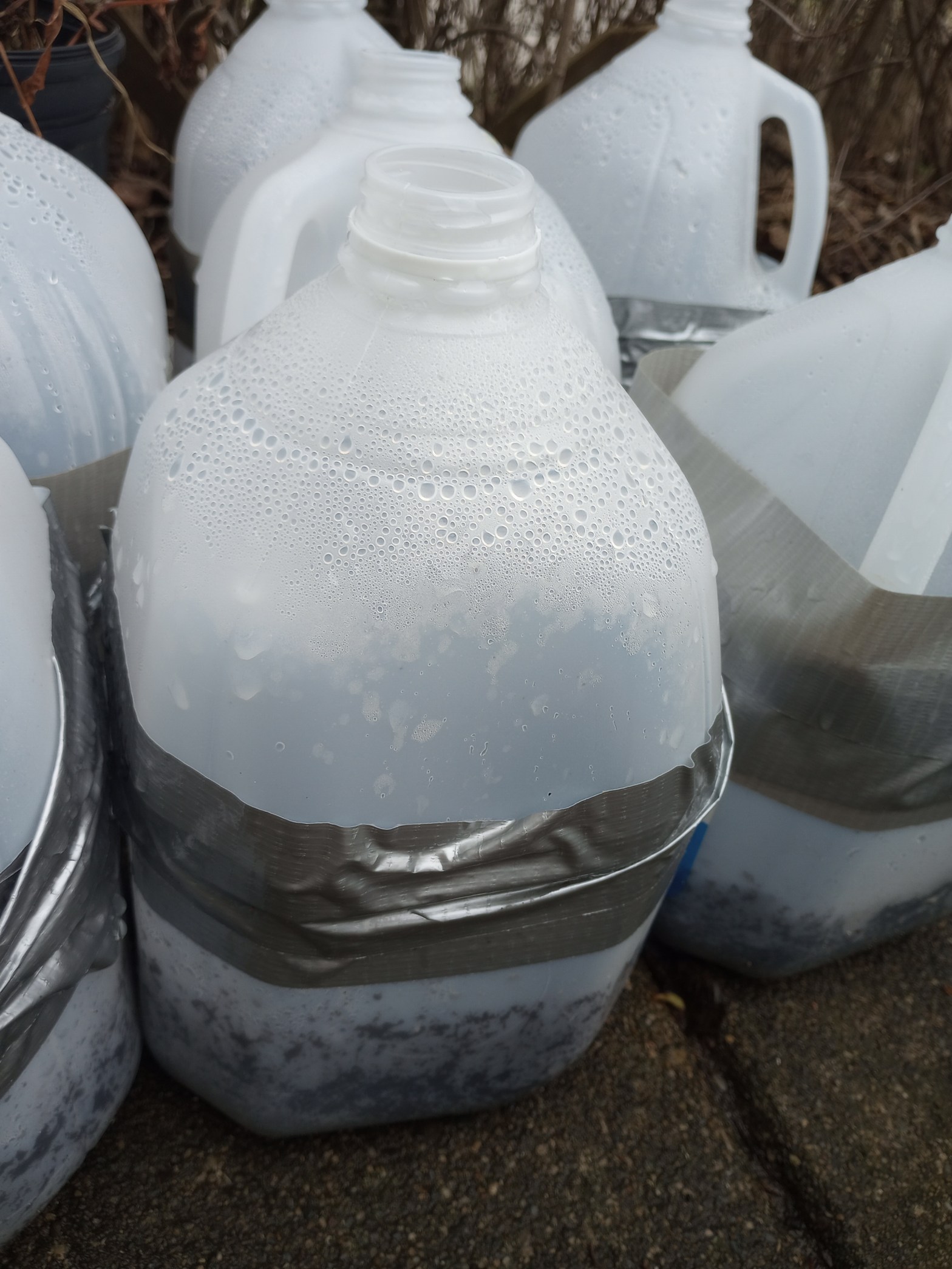
Unlike growing vegetables in your garden, seeds from most trees, shrubs and native plants in the north will not germinate unless they go through a cold period. That cold period is referred to as “stratification.” This post will describe the process that I go through for growing small quantities of plants using a technique called “winter sowing.” Winter sowing is a technique developed and made popular by Trudi Greissle Davidoff.
Winter Sowing is a marvelous technique because it is simple yet highly effective. It involves planting your seeds in a milk/water jug, which provides the perfect environment for growing and nurturing young trees. The container acts as a terrarium to maintain optimal moisture and also protects from rodent and bird damage. I’m rather prone to neglecting my plants in the spring due to busyness, so I know firsthand the ruggedness of this technique. As of this writing, I have a two-foot maple tree that was abandoned two years ago until this past spring. It lived for two years with total neglect.
FRESH VS DRIED SEEDS – Seeds lose viability over time – some quicker than others. So if you have the option, collect your own seeds from the specimens that you admire, and plant them right away. Now, just because you plant them immediately, it doesn’t mean they don’t need to go through the stratification process. Several years ago, I planted some red maple (Acer rubrum) seeds immediately after harvesting them in late May/early June. I still used the winter sowing technique for maintaining humidity levels. Several of the seeds germinated within weeks after sowing. However, the following spring I was surprised to see newly germinating trees that were several times the quantity that germinated 10 months previously. Sometimes you only have access to dry seeds, and the following instructions are the steps that I follow.
SOAKING – Growing trees from dried seeds usually involve soaking them in water overnight to start the germination process. Many seeds need special treatment to get them activated, but that is above the scope of this basic process and will not be discussed now. The simplest treatment involves using hot water to break down the seed coat instead of the regular cool water soaking process. You will need to follow the prescribed treatment given on the seed packet or research your specific seed variety to determine if a special treatment is needed.
PLANTING – After soaking the seeds for 24 hours, place them in your winter sowing container. This is typically a milk/water jug that cut open and punctured for drainage. I cut around the perimeter of the jug at the base of the handle, but leaving a small section intact effectively making a hinge. The jug is then filled with your preferred planting mix. I personally prefer the Pro-mix brand because it wets very easily as compared to other brands I have used. I will moisten the growing mix if it is not already damp. The seed is then covered with a small amount of planting mix to the appropriate level (typically 1/8-1/4 inch for maple and apple seeds) and then pressed slightly to firm. Some seed varieties are not covered at all because they are light-dependent, and some other varieties can be planted deeper. It is sometimes a challenge to estimate the depth, especially when the planting mix contains lumps, perlite or other coarse materials. Just do your best estimate; this step doesn’t happen in nature. Next, seal the jug back up using duct-tape and place it outside in a somewhat protected location where it will still be exposed to precipitation. Under brush or on the north side of a shed are perfect locations. Be sure to remove the cap if you have not done so already.
PATIENCE – You mostly just wait at this point. Keep an eye on the jugs. You should see some condensate on the sides. If temps are above freezing and there has been a long dry spell, water by spraying the just as if they were open. Most of the water will not go into the jug because of the narrow opening, but it really does work. Peak inside the jug and the growing mix should appear moist as indicated by a dark coloration.
NURTURING YOUNG PLANTS – If everything goes well, you will have young plants growing in the spring. You don’t need to do anything at first; just enjoy the rewards of your effort. Keep an eye on the growing mix to ensure that it doesn’t dry out. I live in the Midwest, and the soil doesn’t typically dry out in the spring. We have frequent precipitation, and the jug acts as a terrarium to maintain the moisture level. Fertilize the plant once it develops its first true leaf. Plants are provided with nutrients from the seed, so fertilization is not needed until the first true leaf develops. The first leaf is called a cotyledon and doesn’t look like the typical leaf for that tree variety. So don’t give any fertilizer to your young plants until the first true leaf has developed.
TRANSPLANTING – Once the first true leaf has developed, you can transplant into another container. I usually sow several seeds and then transplant each of the sprouted plants into an individual pot. This saves the effort of planting every seed into its own individual pot because not all seeds will germinate. Some varieties have very low germination rates. There is no rush to transplant. If you just have a few plants growing, and they are not crowding each other out, you can let them grow right in the jug for a while. They are protected from drying out and getting eaten so long as they are in the jug. I usually have a very high mortality when I germinate seeds without protection. Something will always nibble the tender top growth off, leaving the stem to wither away. Actually, the seed is often eaten by a rodent before it even has a chance to germinate. In my experience, the risk seems to be reduced as time goes on. Perhaps this is due to availability of other food sources or perhaps the plant is not as delicious. I still keep the plants protected as they are growing or some creature, such as a groundhog or squirrel will surely mess with them. The next high-risk period comes in autumn when squirrels start digging in every location of bare earth they encounter.
I sincerely hope that this brief article is found to be helpful. It is very general but does outlines the various steps that I follow to grow trees and shrubs from seed. There are many resources and social media groups that talk about these various steps in great detail, and where specific advice is shared. I wish you success on your endeavor should you try sprouting some seeds.
 Up North Grown